Sierra Leone trains 95 cassava seed entrepreneurs to expand access to clean planting material
IITA and partners ran a two-day training for 95 commercial cassava seed entrepreneurs in seed multiplication and Semi-Autotrophic Hydroponics so they can deliver clean, improved cassava planting...

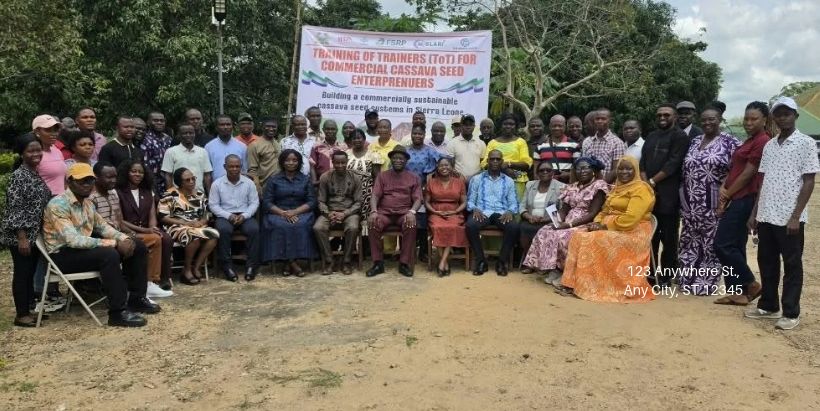
The International Institute of Tropical Agriculture (IITA) and partners ran a two-day Training of Trainers for commercial cassava seed entrepreneurs at Taiama Lodge in Moyamba District on 5-6 October. Ninety-five participants from government agencies, universities, farmer organisations and the private sector were taught cassava seed multiplication and Semi-Autotrophic Hydroponics (SAH) so they can take clean, improved planting material to farms.
This story adds FAO production figures and an analysis showing how SAH plus certified seed entrepreneurs could help close part of Sierra Leone's large cassava productivity gap, a context not quantified in IITA's release.
Training participants at Taiama Lodge during the two-day commercial seed entrepreneur training in Moyamba District. Photo: International Institute of Tropical Agriculture (IITA). (Lead photo file attached in the CMS record: iita-cassava-training-lead.jpg.
Cassava is Sierra Leone's second staple after rice and a major part of the country's agricultural output. The FAO's country investment profile shows cassava supplies about 57.4% of Sierra Leone's agricultural GDP, producing roughly 2.6 million tonnes on about 155,706 hectares. Average yields are around 15 tonnes per hectare against a technical potential of about 60 tonnes per hectare, leaving one of the widest productivity gaps of any crop in the country. Our earlier report on the ECOWAS and AfDB rice programme sets national food-security and seed-system context for why improving staples matters across the region.
The training was organised by IITA under the Food System Resilience Programme (FSRP), in partnership with the Sierra Leone Ministry of Agriculture and Food Security (MAFS) and the Sierra Leone Agricultural Research Institute (SLARI). IITA says its technical assistance is delivered via the World Bank-funded FSRP to support the government's Feed Salone agenda and scale proven technologies.
Semi-Autotrophic Hydroponics is a low-cost propagation method researchers now use to multiply clean cassava planting material faster than traditional stem multiplication. In SAH, modified potting material holds roots with only a small amount of water; the top of the medium stays relatively dry so roots grow downwards and the plants avoid damp-off and other moisture-related diseases. SAH raises multiplication ratios quickly and is cheaper than tissue culture, making it suitable for early-generation seed businesses and local seed entrepreneurs to produce large numbers of disease-free planting materials.
A demonstration of Semi-Autotrophic Hydroponics trays used to multiply cassava planting material. Photo: International Institute of Tropical Agriculture (IITA).
Speakers at the training underlined that technology alone is not enough. Dr Jebeh Samba, team lead for the SAH Lab, told participants the knowledge they gain will only translate into development when it is applied and shared. Dr Alfred Dixon, chairman of the SLARI board, stressed that lasting impact depends on putting the national seed roadmap into action. Isatu Bailey, Station Administrator at IITA Sierra Leone, said certified seed entrepreneurs are the engine that will bridge research and farmers by delivering varieties through trusted seed systems and market links.
Dr Jebeh Samba speaking to participants about SAH technology. Photo: International Institute of Tropical Agriculture (IITA).
Seed entrepreneur Bintu Monika Nyanda Jibao shared her experience running a seed business and training more than 1,300 farmers, demonstrating how cassava can be both a food and an income crop if improved seed reaches communities.
Seed entrepreneur Bintu Monika Nyanda Jibao sharing her experience training farmers and running a seed business. Photo: International Institute of Tropical Agriculture (IITA).
The training aims to create a community of practice linking research, extension and enterprise so new varieties move faster from SLARI breeding stations to farmers. That policy push has a national anchor: President Julius Maada Bio launched 30 new seed varieties and opened a National Seed Testing Laboratory on 9 October 2025 as part of the Feed Salone strategy, calling on government agencies, seed producers and the private sector to multiply and distribute the varieties nationwide.
Photo: International Institute of Tropical Agriculture (IITA)
Newzroom dot Africa has reached out to International Institute of Tropical Agriculture and Sierra Leone Agricultural Research Institute for comment and is awaiting a response. This story will be updated when they respond.
Source: IITA