South Africa's MeerKAT detects very large hydrogen atoms in a galaxy 7.3 billion light years away
The MeerKAT Absorption Line Survey detected hydrogen Rydberg atoms at redshift 0.89 towards PKS 1830-211, letting astronomers probe ionised gas and star formation in a distant galaxy.
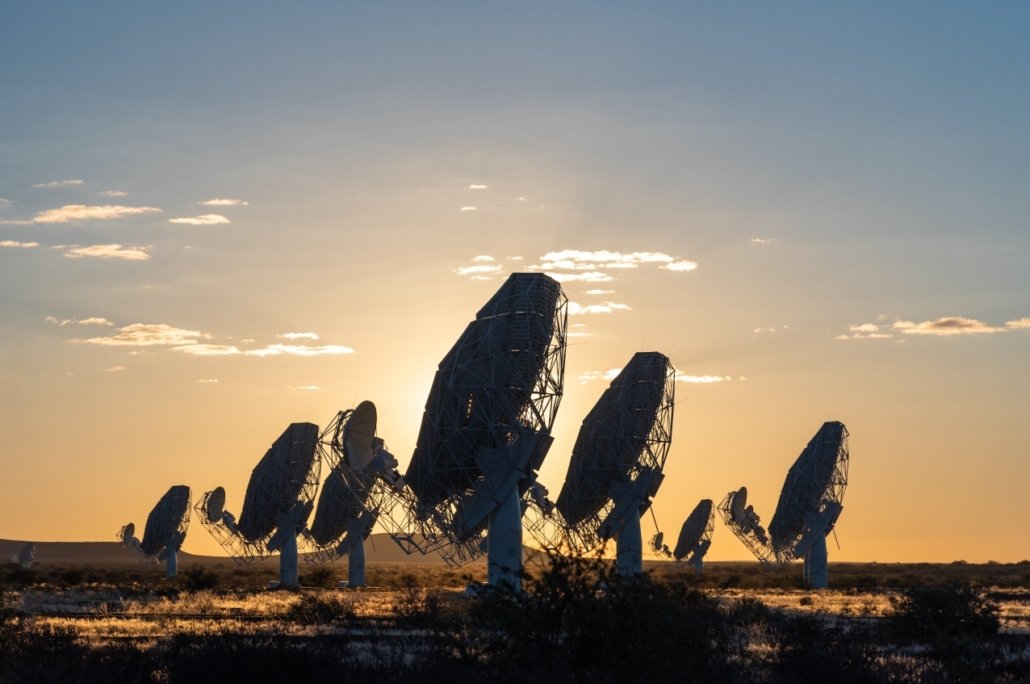
South Africa's MeerKAT radio telescope has detected very large hydrogen atoms, called Rydberg atoms, in a galaxy about 7.3 billion light years away. The signal comes from a foreground galaxy at redshift 0.89 that lenses the bright radio source PKS 1830-211, and the finding offers a way to probe ionised interstellar gas, star formation and black-hole fuel across cosmic time.
MeerKAT is a 64-antenna array sited inside a radio-quiet zone about 90 km outside the small Northern Cape town of Carnarvon. It is a South African-built precursor to the Square Kilometre Array and will be integrated into the SKA mid-frequency component in Phase 1. The detection underlines MeerKAT's role as one of the most sensitive radio instruments at centimetre-to-metre wavelengths.
Rydberg atoms are ordinary atoms whose electrons sit in very high energy levels. When a strong radio background shines through ionised gas under the right conditions, the atoms produce amplified radio emission known as radio recombination lines, or RRLs. That stimulated emission is stronger when the background radio source is bright, so a bright, lensed quasar like PKS 1830-211 acts like a flashlight that makes otherwise faint transitions visible even at great distances.
The result comes from the MeerKAT Absorption Line Survey, or MALS. The team stacked many individual RRLs and report clear detections of H144alpha and H163alpha at observed frequencies near 1156 MHz and 798 MHz. The stacked signals are highly significant: about a 21-sigma detection for H144alpha and a 14-sigma detection for H163alpha. The survey also reports 44 separate spectral fingerprints consistent with Rydberg atoms along this sightline.
The authors used the RRL strengths to model the ionised gas along the two lensed sightlines. Towards the north-east lensed image they estimate an electron density of order 100 cm^-3 (plausible range roughly 20 to 1,000 cm^-3) and a path length around 0.2 parsec. Towards the south-west image the gas appears denser and much more compact, with an electron density of order 1,600 cm^-3 (roughly 160 to 4,000 cm^-3) and a path length near 0.002 parsec. The paper translates those numbers into a star-formation surface density of about 0.6 solar masses per year per square kiloparsec, or a total star-formation rate near 50 solar masses per year for a galaxy of stellar mass about 1e11 solar masses.
Kimberly Emig, lead author of the paper and a Jansky Fellow at the National Radio Astronomy Observatory, said the team used hydrogen Rydberg atoms to study the physical and dynamic structures in the galaxy towards PKS 1830-211, that the atoms likely come from large clouds of gas ionised by radiation from young massive stars, and that this implies the interstellar gas in this galaxy is denser than in the Milky Way.
Neeraj Gupta, astronomer at the Inter-University Centre for Astronomy and Astrophysics and lead investigator of MALS, said RRLs probe ionised gas in a way that complements the survey's searches for neutral hydrogen (HI) and hydroxyl (OH) absorption, and that studying ionised gas with hydrogen Rydberg atoms can help explain how the properties of galaxies change at different ages of the Universe.
The detection was made possible by MALS targeting the brightest radio sources with wide instantaneous bandwidths. MALS observes roughly 580-1670 MHz (about 18 to 52 cm) and plans some 1,655 hours of MeerKAT time; the PKS 1830-211 observations alone produced about 1.6 petabytes of raw data that were processed through a CASA-based automated pipeline at a high-performance computing facility at IUCAA in India with support from NRAO and collaborators.
For African astronomy the result is twofold. Practically, it shows that MeerKAT and surveys such as MALS can detect faint, stimulated radio signals from ionised gas at cosmological distances, opening a new diagnostic for studying how gas in galaxies is ionised and how that relates to star formation and black-hole activity. Strategically, the detection demonstrates the scientific value of the South African facility as a pathfinder for the SKA: the same techniques should scale up with SKA and future arrays to map ionised gas in many more distant galaxies.
The results are reported in Kimberly L. Emig et al., "Discovery of Hydrogen Radio Recombination Lines at z=0.89 towards PKS 1830-211", arXiv:2301.03115 (2023); the paper has been accepted for publication in the Astrophysical Journal. The MALS survey will continue its planned observations to search for HI, OH and related RRL signatures across 0 < z < 2, which should allow the team to look for similar RRL detections along many more sightlines.
Newzroom dot Africa has reached out to South African Radio Astronomy Observatory and Inter-University Centre for Astronomy and Astrophysics for comment and is awaiting a response. This story will be updated when they respond.
Source: SARAO