New map finds health modelling clustered in Nigeria, South Africa and Kenya, with gaps
ModHA Phase 1 mapped 118 health-modelling institutions across 28 African countries (75 confirmed as of 23 Nov 2026), and found hubs in Nigeria, South Africa and Kenya plus gaps in several regions...

28 November 2026
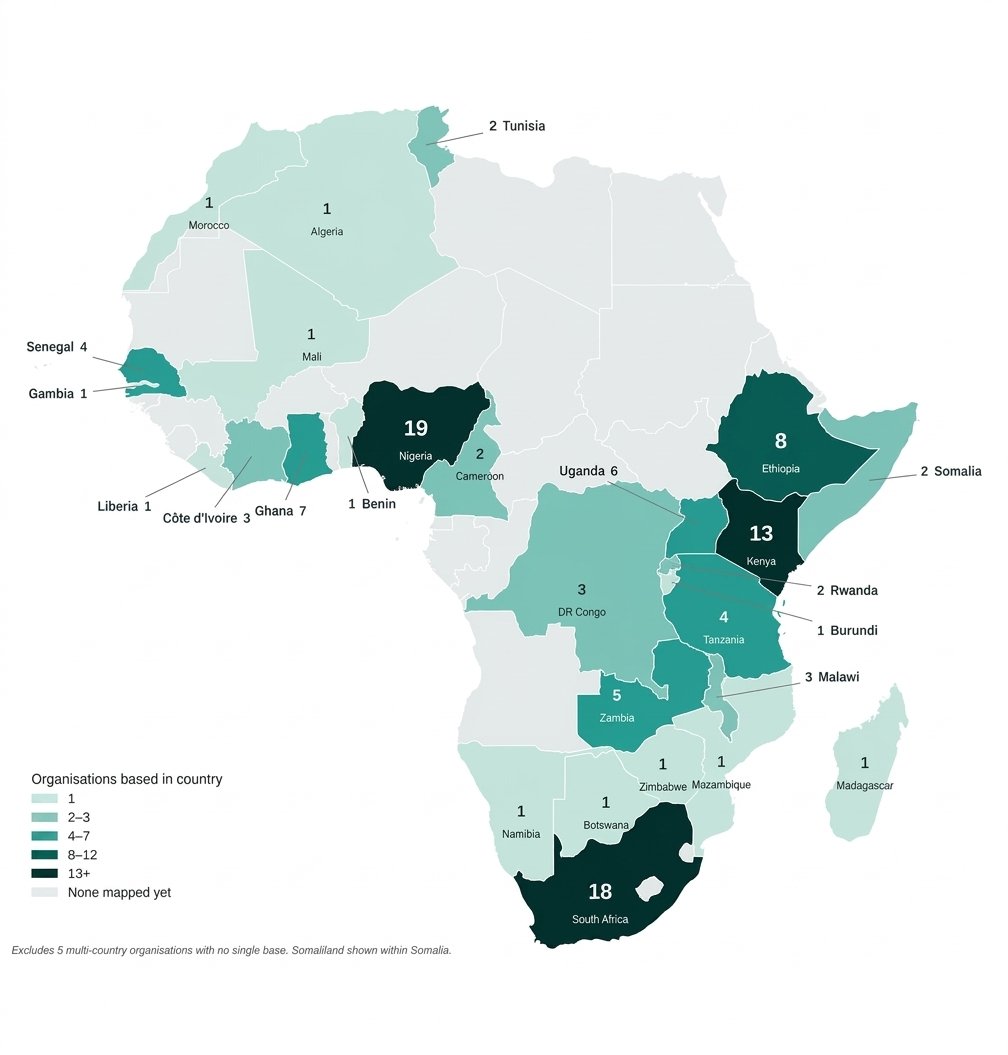
The Modelling for Health in Africa (ModHA) Phase 1 mapping identified 118 health-modelling institutions, networks and initiatives across 28 African countries, with data current to 23 November 2026. Of those 118 entries, 75 have so far been confirmed.
Phase 1 covers 28 African countries. Coverage is uneven and many countries have few visible health-modelling teams recorded on the ModHA map.
ModHA Phase 1 public map showing mapped modelling organisations across 28 African countries; many countries in Central and North Africa show few entries.
Science for Africa Foundation has published a public ModHA Phase 1 map and press page.
The Phase 1 data show activity concentrated in a few hubs: Nigeria (19 organisations), South Africa (18) and Kenya (13) together account for more than 40% of the entries. Universities make up about 40% of the organisations on the list, followed by research institutes and multi-partner networks and consortia. Nearly half of the mapped organisations operate beyond a single country, including 29 the ModHA team identifies as having pan-African reach.
Representative national modelling groups include the Nigeria Centre for Disease Control (NCDC). During the COVID-19 pandemic, NCDC used mathematical models to assess the likely effects of lockdowns, quarantine and public-sensitisation measures; those analyses helped plan hospital resources and guide policy decisions, according to reporting by Nigeria Health Watch (Nigeria Health Watch).
Thematic coverage is uneven. Most modelling work mapped focuses on infectious diseases and malaria, followed by TB and HIV. Areas such as climate and health, non-communicable diseases and women's and maternal health are less represented. Methods are also dominated by mathematical and epidemiological approaches; AI, machine learning and spatial methods are still rare among the entries ModHA captured.
The mapping highlights a risk for countries without nearby teams: health modelling now informs national strategic plans, investment cases and epidemic response, and countries without local expertise may be slower to get context-specific analysis when they need it.
The Science for Africa Foundation set out Phase 2 plans in its Phase 1 release: "In that phase, we will validate and expand the mapping through outreach to partners, networks and institutions, filling the gaps Phase 1 revealed."
If your institution is missing from the list, or if you want to confirm or update your details, the Modelling for Health in Africa mapping form is open for entries; every confirmed entry helps governments, funders and modellers find one another and build a more connected, African-led modelling community.
Newzroom dot Africa has reached out to Science for Africa Foundation, Gates Foundation and Wellcome for comment and is awaiting a response. This story will be updated when they respond.
Source: Science for Africa Foundation