Ghana installs transportable radio telescope for student training, satellite tracking and transient searches
A 24-element "TART in a box" array assembled at a GSSTI workshop in August 2025 will train students in Ghana, provide continuous satellite tracking and search for brief cosmic radio bursts.
Published: 15 Nov 2026
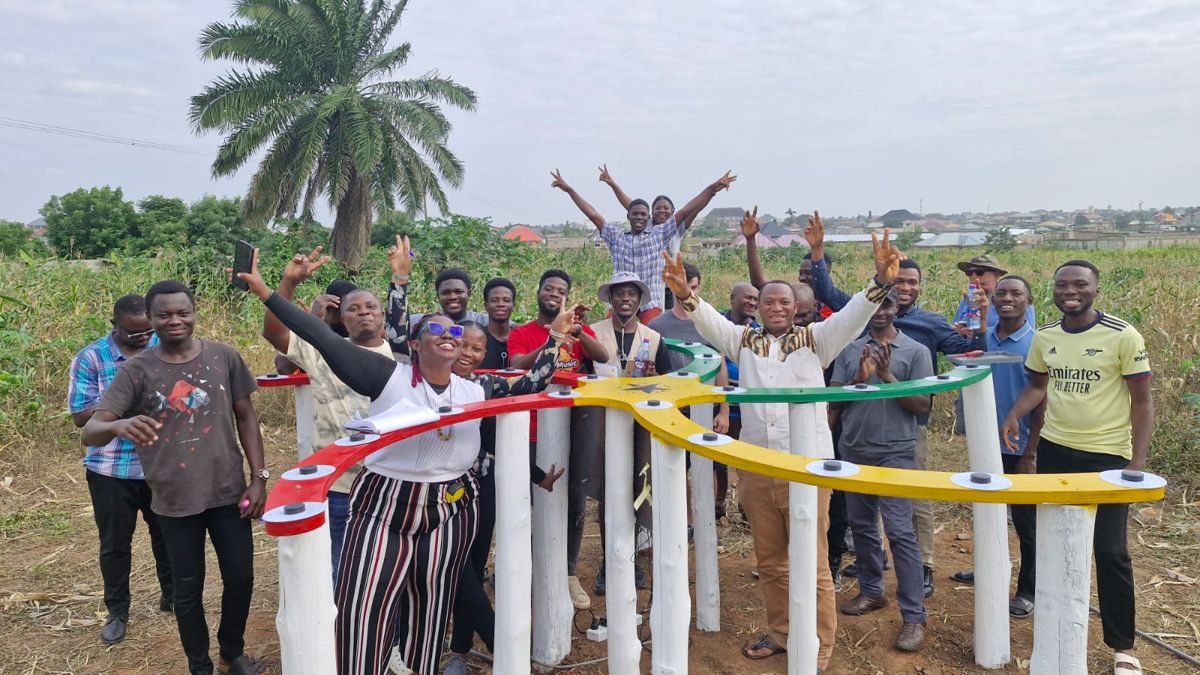
Installation team members and students pose around the assembled TART 'in a box' 24-element antenna at the GSSTI workshop in Ghana, August 2025. (Image: SARAO) Alt text: Students and installation team with TART 'in a box' 24-element antenna.
Ghana has installed a small, transportable radio telescope to give students hands-on training, to track satellites continuously and to search for brief astrophysical radio signals. The 24-element "TART in a box" array was completed at a workshop hosted by the Ghana Space Science and Technology Institute (GSSTI) from 18 to 22 August 2025, SARAO says in its announcement.
The Ghana deployment is the sixth TART installation. The TART project's live map and documentation list earlier roll-outs in Kenya and Mauritius in 2024 and in Botswana, Zambia and Hammanskraal, South Africa in 2025. The wider initiative aims to build a network of low-cost, transportable radio telescopes across partner countries in Africa to broaden practical training, scientific collaboration and technical skills.
TART continuously monitors the sky in the GPS radio band, used by navigation satellites, which lets the array track satellites as well as search for transient events - brief bursts of radio emission that can reveal energetic processes in the universe. The project's pages describe the array as a testbed for imaging and calibration algorithms and for developing radio-astronomy data-processing techniques.
The "TART in a box" kit breaks down into flat parts that fit in regular checked luggage and can be quickly assembled on site, avoiding the need for custom fabrication at each host location. The basic idea began with a volunteer in New Zealand, and EMSS Antennas developed and sponsored the manufacturing process to support local South African suppliers, the project says.
The Ghana workshop was run with partners from South Africa and New Zealand. The effort is led by Dr Tim Molteno (University of Otago / Electronics Research Foundation), Professor Oleg Smirnov (Rhodes University) and Dr Benjamin Hugo of the South African Radio Astronomy Observatory (SARAO). The programme receives support from SARAO and from the Development in Africa with Radio Astronomy project (DARA).
"It is a very nice development, because we no longer need to worry about having the structure manufactured on-site. This has been a source of risk in the past due to different sites not necessarily having access to the right facilities," said Professor Oleg Smirnov in a SARAO announcement.
More information, documentation and a live map of TART deployments are available from the TART project site, SARAO's news post on the Ghana installation, and the DARA project pages.
Source: SARAO