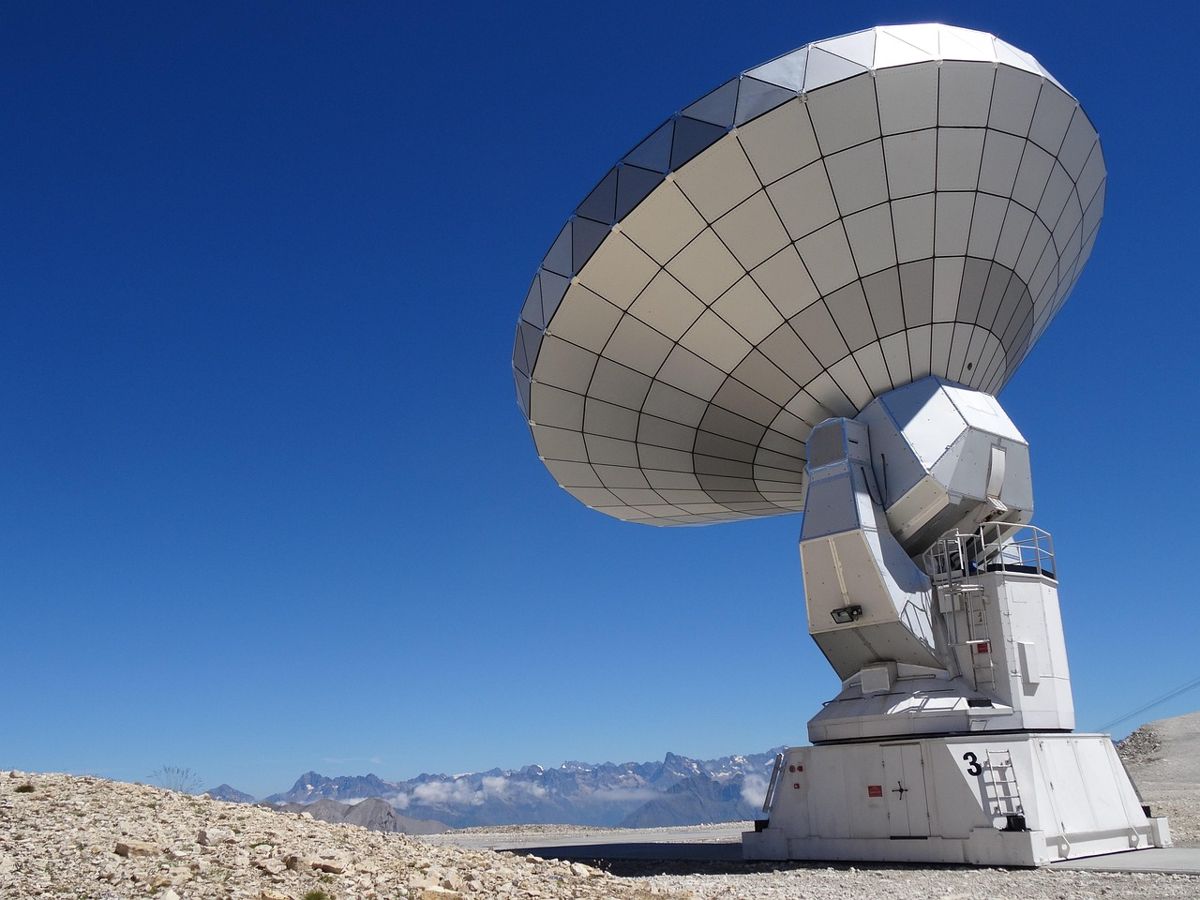
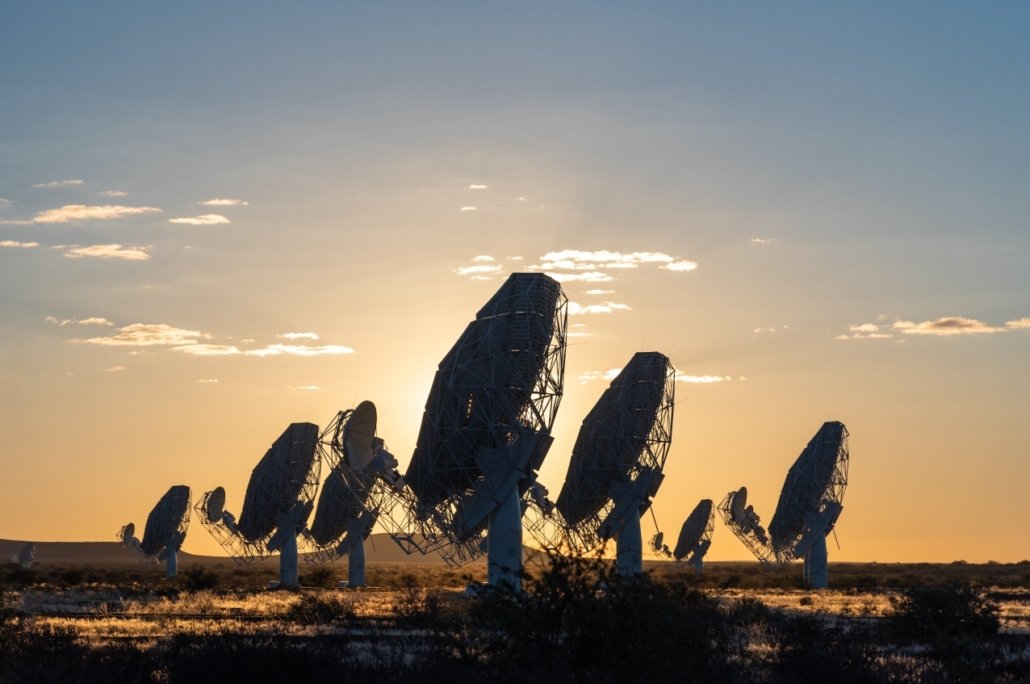
15-m SKA prototype dish at Karoo began science operations in 2024; observing open to South African researchers
The 15 m SKA-MPIfR prototype dish at the Karoo SKA site completed technical commissioning and began early science work in 2024.
The SKAMPI first-light image of the Southern Sky at 2.5 GHz, showing the Galactic Centre and Centaurus A. Credit: SKAMPI Team. Alt text: SKAMPI first-light image of the Southern Sky at 2.5 GHz showing the Galactic Centre and Centaurus A.
Published: 18 November 2026
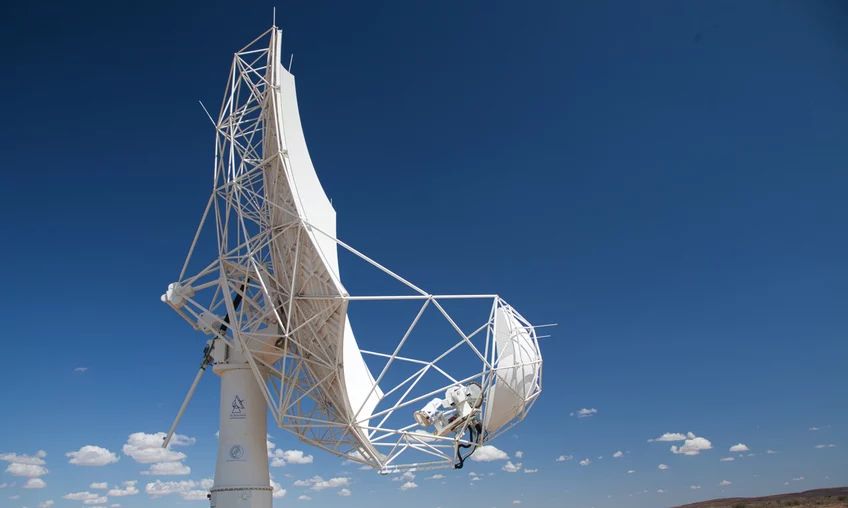
The SKA-MPIfR prototype dish known as SKAMPI, a 15 m antenna hosted at the Karoo SKA site, completed technical commissioning and is ready for science operations, with requests for observing time to be open to the South African community and opportunities for education programmes for schools and universities.
SKAMPI was designed by the Max Planck Institute for Radio Astronomy (MPIfR) with partners CETC54 and OHB Digital Connect GmbH, and funded by the Max Planck Society and the South African Radio Astronomy Observatory (SARAO). The antenna was fully assembled at the Karoo site in mid 2018. Initial tests began in December 2019 and technical commissioning, including system evaluation and radio-frequency-interference (RFI) testing, continued through early 2022.
"With a fully digital frontend, SKAMPI has two receiver units, for the S-band between 1.75 GHz and 3.5 GHz and for the Ku-band between 12.0 GHz and 18.0 GHz," says Gundolf Wieching, head of the Electronics Technical Division at MPIfR. The MPIfR team says the backend is a high-performance computer system that uses graphics processing units (GPUs) to accelerate signal processing and can be adapted for pulsar searches, spectropolarimetry and very long baseline interferometry (VLBI).
"We have performed first-light observations with SKAMPI in the S-band at frequencies between 1.75 and 3.5 GHz, demonstrating the telescope's spectral and pulsar capabilities with imaging of the radio emission of the Southern Sky and detection of the Vela pulsar," says Hans-Rainer Klockner, SKAMPI project scientist at MPIfR. Project teams say they have 40 times more observations to process toward a first total-power S-band southern-sky survey.
The SKAMPI first-light image demonstrates the telescope's imaging mode and spectral performance. The team observed the southern sky on two consecutive nights at a slewing speed of 2.5 degrees per second; although the uncalibrated measurements were affected by RFI and system variations, the image already shows the Milky Way and external galaxies such as Centaurus A.
SARAO provided specialised personnel and resources to identify and rectify sources of radio-frequency interference so the antenna met SARAO and the SKA Observatory RFI requirements. SARAO also developed and integrated several SKAMPI subsystems, including the dish fibre network and the single-pixel feed controller, and assisted with updating cryo-compressor hardware.
"For SKAMPI, we have extended our software system so that computing resources not needed for the real-time signal processing of the current observation can be used by scientists for first automated analyses," explains Tobias Winchen of MPIfR. The team plans dedicated programmes to monitor pulsars and variable sources, follow up fast radio bursts in small VLBI arrays, and refine calibration and robotic operation strategies.
First-light observations of the Vela pulsar with SKAMPI show an uncalibrated pulsar signal as the beam sweeps over the Earth and the same signal resolved in frequency across the full S-band. Credit: SKAMPI Team.
This report is based on announcements and technical notes from the South African Radio Astronomy Observatory, the Max Planck Institute for Radio Astronomy and the SKA Observatory.
Newzroom dot Africa has reached out to South African Radio Astronomy Observatory for comment and is awaiting a response. This story will be updated when they respond.
Source: SARAO