UNILAG hackathon asks students to pitch ways to stop plastic reaching Gulf of Guinea
Students at a PROTEGO Blue hackathon at the University of Lagos on 19 November pitched youth-led ideas to stop plastic waste entering the Gulf of Guinea.
Published: 22 November 2026
Students at the PROTEGO Blue Innovation Hackathon at the University of Lagos were asked to pitch practical ideas to stop plastic waste from reaching the Gulf of Guinea. The PROTEGO Blue event was held at the TETFund Centre of Excellence in Biodiversity Conservation and Ecosystem Management (TCEBCEM) at the University of Lagos, with the final pitch at ACEDHARS Hall on Thursday, 19 November 2026.
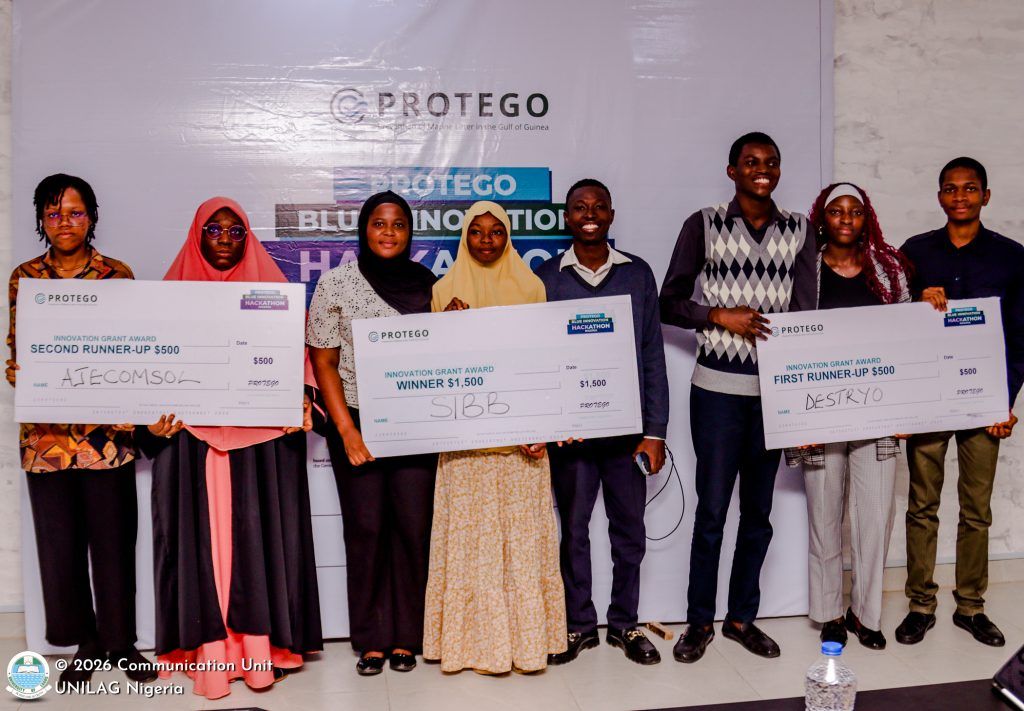
Students at the PROTEGO Blue Innovation Hackathon at the University of Lagos pose on stage holding oversized prize cheques. Image: University of Lagos
The lead image shows students on stage holding oversized prize cheques after the final pitch.
PROTEGO project literature says West African countries including Nigeria and Ghana are among the region's contributors to marine debris.
PROTEGO stands for Prevention of Marine Litter in the Gulf of Guinea. The three-year project is funded by the German Federal Ministry for the Environment, Nature Conservation, Nuclear Safety and Consumer Protection (BMUV) under its Grant Programme against Marine Litter and is led by adelphi research gGmbH. Implementing partners named at the event include WASTE Africa, the Nigeria Climate Innovation Centre, Plastic Punch and the Ghana National Cleaner Production Centre. The PROTEGO project page is at the PROTEGO project page.
The hackathon drew 72 applications from tertiary institutions in Lagos and Cross River States. Organisers shortlisted 27 students (15 from Cross River, 12 from Lagos). The Cross River State leg concluded earlier, on 11 November 2026, with Team Blue Barrier taking first place. In Lagos the 12 shortlisted participants were reduced to seven finalists, and five teams presented at the final pitch on 19 November.
At the opening, Gabriel Onyebuolise, Programme Manager at WASTE Africa and PROTEGO project representative, set out the project's four approaches: mapping plastic leakage into waterways, testing pilot solutions with local innovators, strengthening institutional systems and policies, and changing public attitudes through school green clubs, beach clean-ups, films and campaigns.
The keynote address, delivered by Dr Temitope Sogbanmu, environmental toxicologist and senior lecturer in UNILAG's Department of Zoology, traced how discarded plastic moves from gutters and drains into larger waterways and on to the coast. The PROTEGO team also showed a short mini-documentary of the Ajegunle intervention site and footage along the Lagos Island corridor, underlining that plastic pollution affects both obvious hotspots and more affluent neighbourhoods.
Still from the PROTEGO mini-documentary showing plastic-clogged drainage in Ajegunle. Image: University of Lagos
The event emphasised that the hackathon is the youth-engagement strand of the wider PROTEGO project, which aims to map leakage, test scalable solutions and feed lessons into policy and local practice. On the ground, PROTEGO says it will map plastic leakage, trial small pilot solutions such as collection, sorting or pilot devices, and run behaviour-change activities with communities in identified hotspots including Ajegunle in Lagos State and Nsidung in Cross River State: PROTEGO project page.
The selected participants underwent a one-week virtual boot camp to strengthen their ideas and were encouraged to test proposals in their communities before the final pitch, aiming for solutions grounded in local needs rather than attractive presentations.
Source: University of Lagos