SALT and Lesedi Help Classify Unusual Stellar System from Rubin Data
South African telescopes are responding to Rubin Observatory alerts. SALT and Lesedi are helping classify a rare stellar system and boosting astro-tourism in Sutherland.

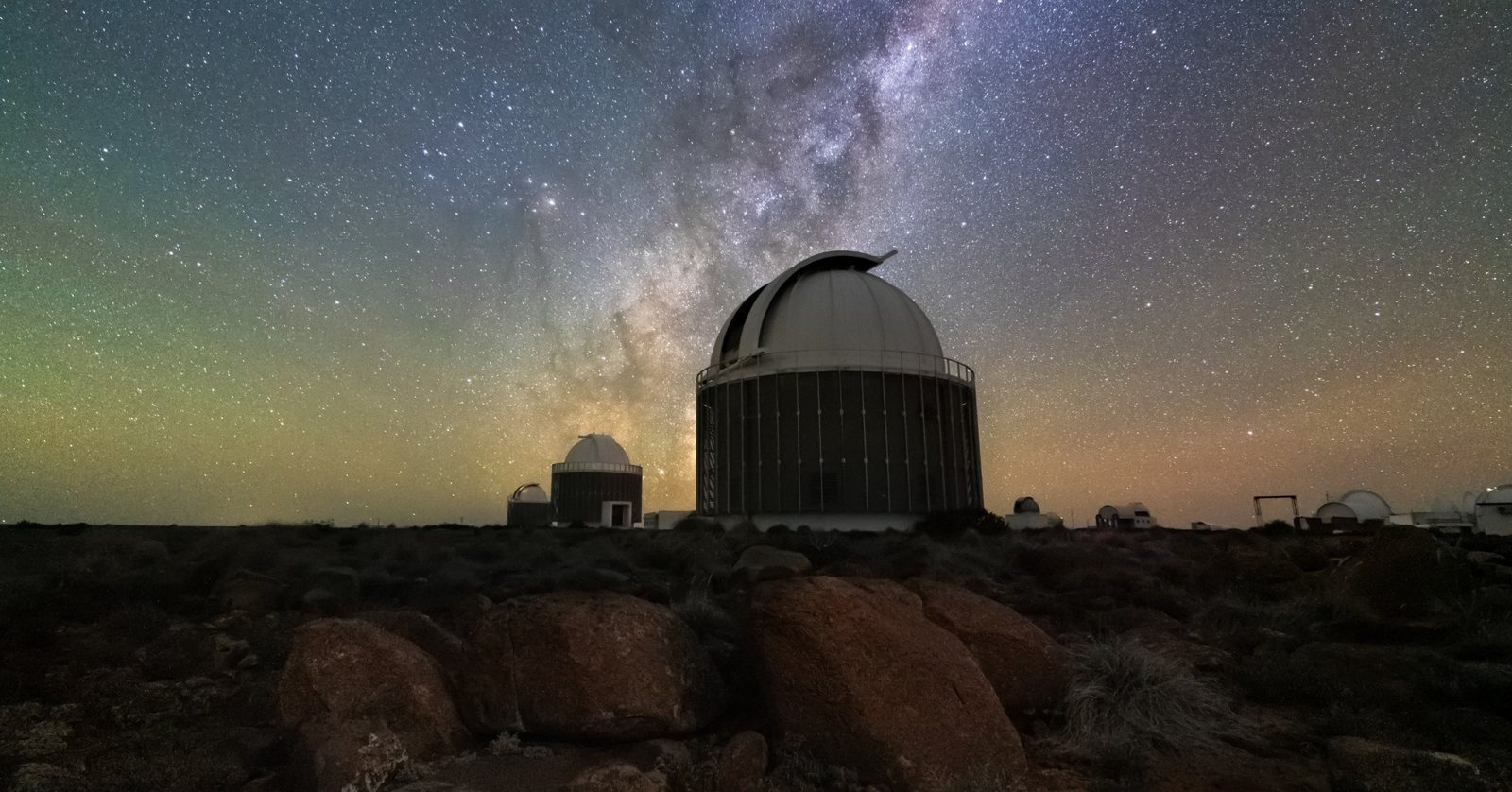
South African astronomers are working with the Vera C. Rubin Observatory to study new cosmic events. Researchers at the South African Astronomical Observatory (SAAO) in Sutherland have used the Southern African Large Telescope (SALT) and the Lesedi Telescope to follow up on Rubin’s transient alerts. Early findings suggest one of the flagged sources may be an unusual compact stellar system.
The Vera C. Rubin Observatory in Chile has begun issuing real-time alerts for transient astronomical events. These alerts identify objects that change brightness or appear suddenly in the sky. The National Research Foundation’s South African Astronomical Observatory (NRF–SAAO) is already responding to these alerts.
In recent observations, SALT obtained spectra of a newly identified variable source. Early analysis indicates the object could be a hot subdwarf star or a cataclysmic variable system. To complement this, the Lesedi Telescope is gathering photometric data to track brightness changes over time. This combined effort links Rubin’s discovery power with local facilities for deeper study.
Online, South African science enthusiasts have expressed pride in seeing local telescopes play a part in a global project. Many highlight the importance of SALT and Lesedi in keeping South Africa at the forefront of astronomy.
Others are speculating whether it could be a rare star system or even a new type of variable object. Some posts frame the collaboration as proof that South Africa is contributing meaningfully to international science.
This development shows how South Africa’s observatories are integrated into global networks that study the dynamic universe. Rubin Observatory’s alerts are expected to transform astronomy by detecting millions of transient events. Without rapid follow-up, many discoveries would remain incomplete.
By combining SALT’s spectroscopy with Lesedi’s photometry, South African astronomers are providing essential data that helps classify and understand these objects. Beyond the immediate discovery, this positions South Africa as a key partner in time-domain astronomy.
The collaboration also strengthens local scientific capacity, ensuring that South African researchers and facilities remain central to international projects. As Rubin ramps up operations, the ability of SAAO to respond quickly will support new insights into stellar evolution, compact systems, and cosmic variability.
This scientific activity also connects to South Africa’s growing astro-tourism sector. Sutherland, home to SALT and Lesedi, already attracts visitors eager to experience dark skies and world-class telescopes. The visibility of Rubin-linked discoveries adds new appeal, drawing tourists and students to see science in action. Astro-tourism supports local economies and builds public interest in science.