Google launches two new TPUs for long-context AI and hardware-level data security
Google Cloud added TPU 8tx for hardware-level confidential inference and TPU 8i Max for million-token context windows, expanding its eighth-generation TPU family to four systems.

Google has added two new AI chip systems to its cloud: one that keeps sensitive data protected even while a model is working on it, and one built to handle very long inputs such as hours of video or documents running to millions of words.
The systems, TPU 8tx and TPU 8i Max, join the two eighth-generation Tensor Processing Units Google announced in April. Google says all four are built for "agentic" AI, where software makes many model calls in a row to finish a multi-step task.
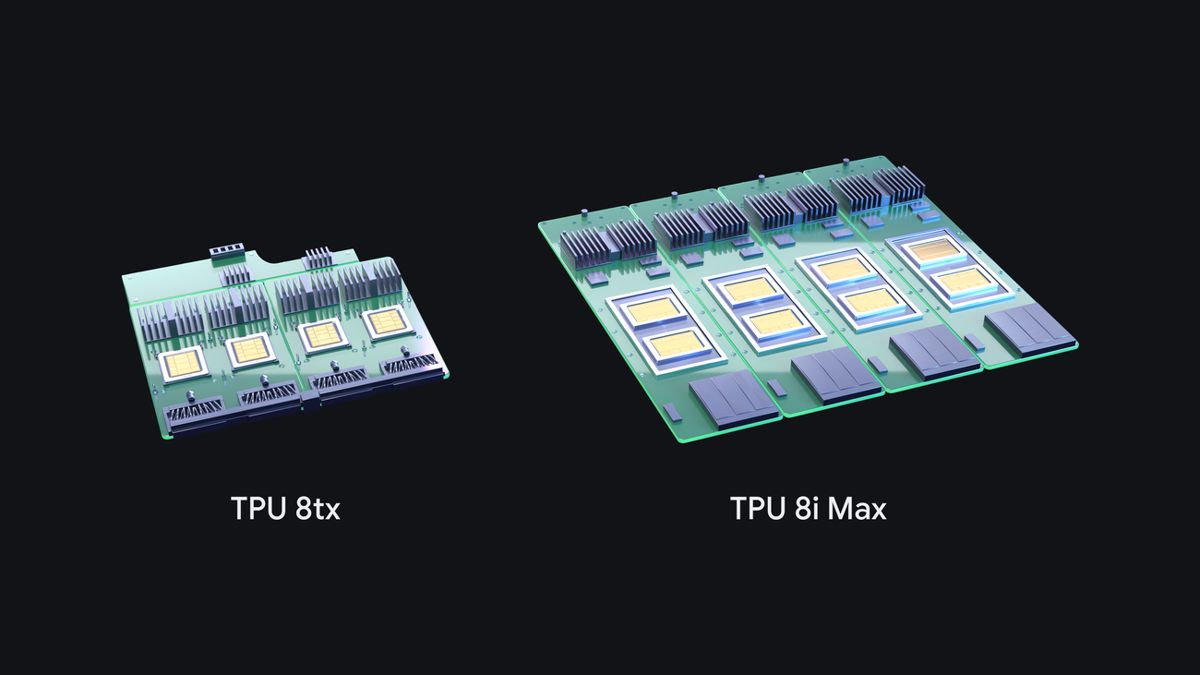
TPU 8tx is aimed at organisations that cannot let private data leave their control, such as banks, insurers and health services. It uses the same silicon as the TPU 8t training chip but adds confidential computing in the hardware, so data and model weights stay protected while they are processed in memory. Google says the protection costs almost nothing in speed and that the system runs with up to twice lower latency than TPU 8t. It is meant for fine-tuning private models and training agents on private data without moving that data around.
TPU 8i Max puts two TPU 8i chips in one package, which Google says doubles the computing power, the on-chip memory and the memory bandwidth, while fitting twice the silicon into the same rack space. The point is to stop long inputs and groups of cooperating agents from stalling while they wait on memory.
Google says its TPUs already run its own Gemini models and have close to 100 outside customers, including AI labs, trading firms, retailers and universities. It has also made the chips easier to use for developers who build in PyTorch, with a tool called TorchTPU that runs their code on TPUs directly.
For customers in Africa there is a catch. Google's own list of where its TPUs run shows none in any African cloud region, including its Johannesburg region; the nearest are in the Netherlands, Chile and Japan. An African bank, insurer or health service that wants these chips has to send its data to Europe or further to use them. The same list shows TPUs of earlier generations in Europe, the Americas and Asia too, and none in Africa. Google has not said why Africa is left out this time; Newzroom dot Africa has asked it whether and when the chips will be offered from its African regions.
That matters most for exactly the sensitive data the confidential TPU 8tx is built for. South Africa's Protection of Personal Information Act sets conditions on sending personal information across borders, so local organisations would need to meet those before using the chips from abroad. Google says some customers can also have TPUs installed in their own data centres.
Why is Africa so often left out when new AI hardware arrives, and what does it cost organisations here? If you work with AI on the continent and have had to send data abroad to do it, Newzroom dot Africa would like to hear from you at press@newzroom.africa.
Google announced the systems on 9 November 2026.
Newzroom dot Africa has reached out to Google for comment and is awaiting a response. This story will be updated when they respond.
Source: Google